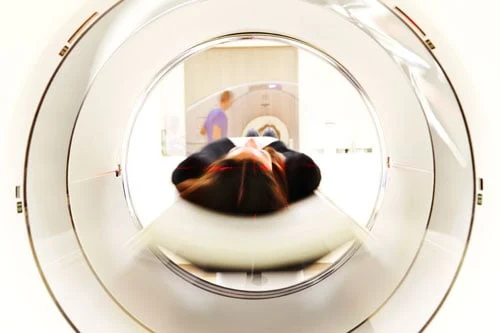
A cardiac MRI uses a magnetic field and radio-frequency pulses to produce highly detailed images of the heart muscles. This non-invasive test allows the cardiologist to detect and monitor cardiac disease with no radiation involved.
MRI machine
01Why It’s Done
Dr Lee may recommend this for patients with:
Detailed assessment of the heart muscle and structure
Investigating cardiomyopathy and heart failure
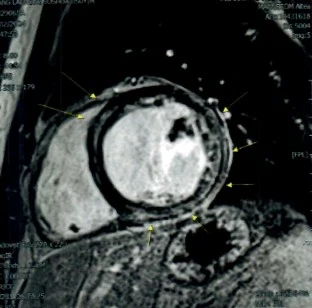
Evaluating cardiac scars after a heart attack or myocarditis
02How It Works
Electrodes are placed on the chest to monitor the heart rate.
You lie still inside the MRI scanner.
Gadolinium contrast is usually injected and scanner captures detailed cardiac images.
Image of cardiac MRI showing LGE
03Duration, Recovery & What To Expect
Cardiac MRI takes around 2 hours. It is painless and uses no radiation. You can resume normal activities immediately afterwards.
04Performed at radiology centres in Orchard area and reviewed by Dr Lee Chee Wan
No. Cardiac MRI uses a magnetic field and radio waves, there is no ionising radiation.
Can I undergo cardiac MRI if I have an implant?
There is no contra-indication for most of the modern orthopaedic and cardiac implants to have cardiac MRI. Please inform Dr Lee and the radiology centre if you have any implant.
Ready to take the next step?
Book a consultation with Dr Lee Chee Wan to discuss this procedure and your heart health.